Term loans and revolving credit lines. PFRS 9 provisioning, a real general ledger with BIR-ready books, scorecard decisioning with live A/B testing, and collections from first reminder to BP 22 filing — with SEC, CIC, AMLA and Data Privacy compliance baked in. Enterprise capability, without enterprise cost or a two-year rollout.
Philippine lenders are forced to choose between million-peso core-banking suites built for universal banks, foreign SaaS that has never heard of the CIC or a DST stamp, or fragile spreadsheets that fall apart at the first BSP examination. LoanOS is purpose-built for the middle — and it is no longer just an origination system: it books revolving facilities, provisions under PFRS 9, closes a period, files with the BIR, and runs a collections floor. Right-sized for an SME, and owned outright rather than rented.
Origination is the easy part. This is the rest of it — the ledger, the provisioning, the statutory filings and the collections floor — shaped around how regulated lending actually works here.
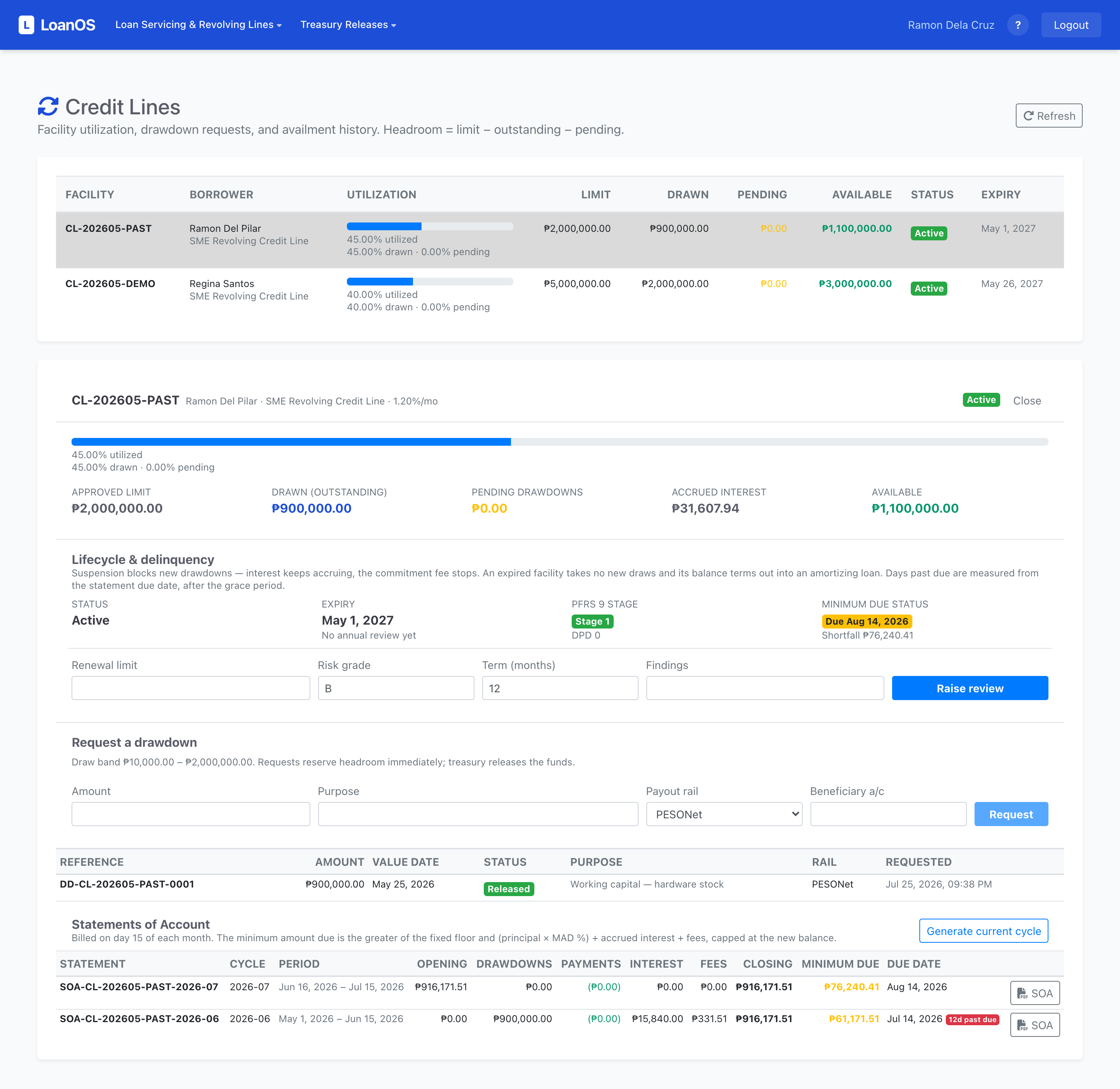
The flagship: a real revolving credit line — drawdowns under a hard headroom lock, daily interest on utilisation, commitment fee on the undrawn portion, cycle statements with a Minimum Amount Due, and limit re-availment that waits for the bank to clear. Term loans run alongside, untouched.
Nominal, EIR, penalty and total-cost ceilings are effective-dated parameters under maker-checker — not constants in someone’s code. Tighten a cap and every product is re-audited; a non-compliant product cannot be saved or activated.
Policy knock-outs, a versioned scorecard engine and auto-approve / refer / decline bands — plus live A/B traffic splits. Assignment is a deterministic hash, so a re-score never changes a decision, and a challenger cannot be promoted on a cohort too thin to mean anything.
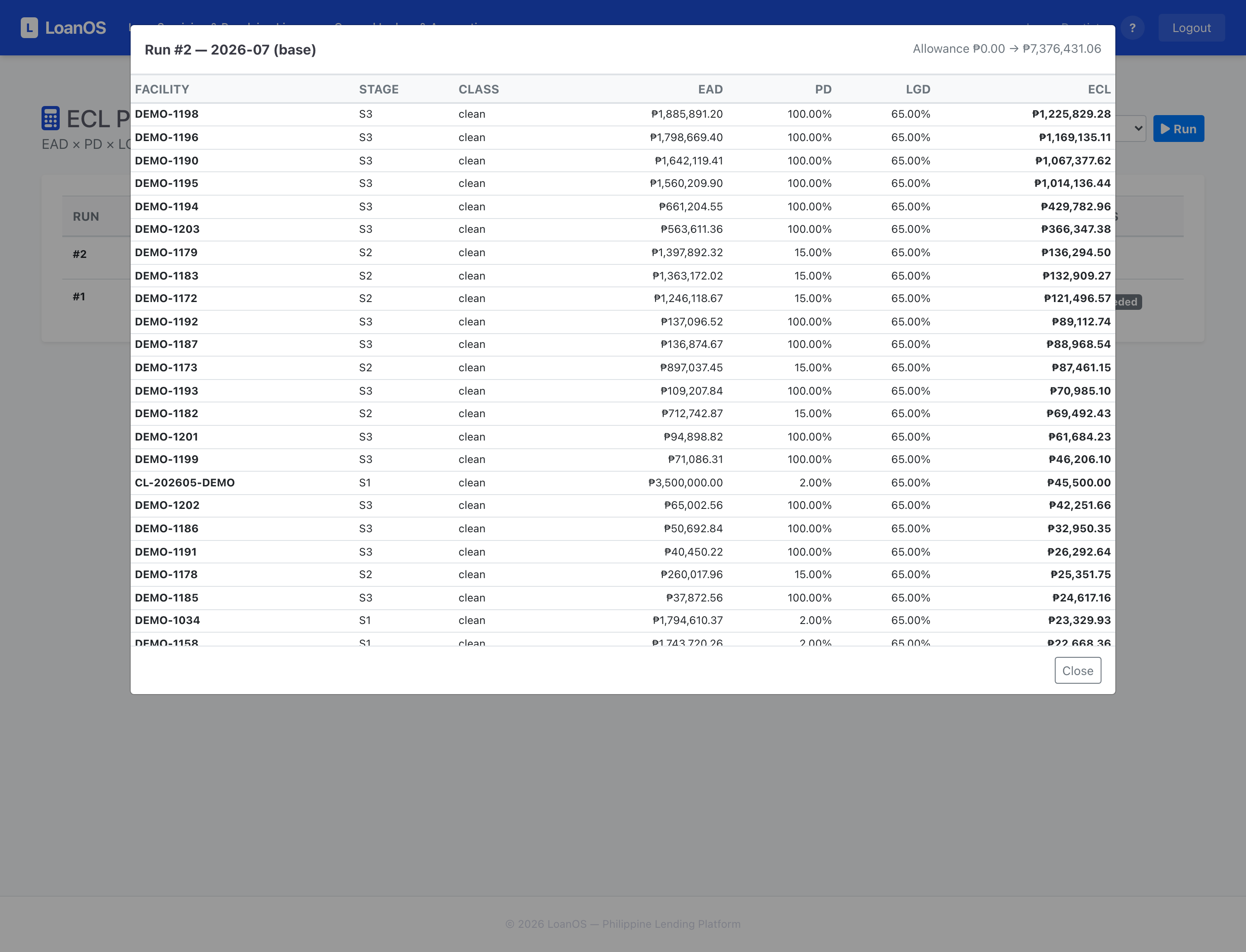
Stage 1/2/3 classification with SICR overlays, effective-dated PD/LGD/EAD tables, monthly provisioning runs that post reverse-and-repost journals, and a movement schedule that ties. Credit lines price EAD as outstanding + CCF × undrawn.
Five-class chart of accounts, multi-line journal vouchers that cannot post out of balance, event-to-GL mapping with an execution log, period close, trial balance, and off-balance-sheet memorandum accounts for PDCs and pledged mortgages — held out of the statutory books by design.
CAS electronic books of accounts, borrower subsidiary ledgers, Form 2307 certificates and tax alphalists — each export hashed into an append-only register. Layouts still awaiting an official spec say so on the face of the file rather than pretending.
PAR-banded worklists, a dialing workbench with promises-to-pay and automatic reminders, capacity-capped queue assignment rules, external agency endorsement with commission accounting, and BP 22 notices with the statutory five-banking-day clock.
Intake QC that rejects a defective cheque before the borrower leaves, barcode-sealed custody with dual control, banking-day presentment, clearing ingestion with return-reason classification, and a legal evidence pack for prosecution.
CIC and AMLA reporting, an immutable audit log, branch-scoped row-level access, per-role MFA policy, and a Data Privacy consent ledger whose erasure workflow masks PII while proving the money trail is byte-for-byte intact.
Not mockups. Every screen below is live in the LoanOS demo environment today.
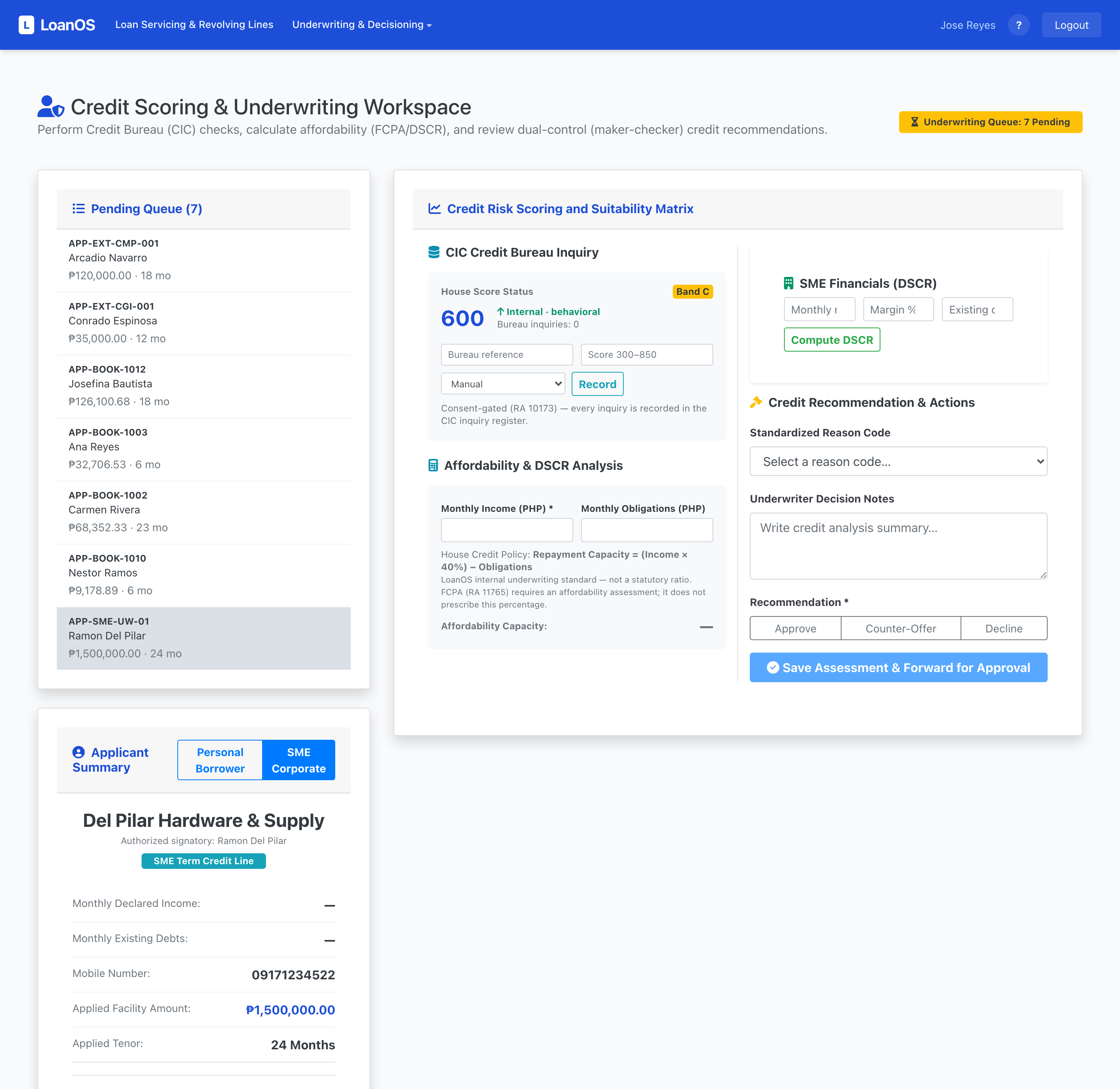
A focused assessment workspace pulls the borrower, the application, bureau results and a house score into one view — with a document checklist that won't let an incomplete file slip through.

Define interest method, rates, fees, DST, penalties and tenor in a single form. The SEC MC 14 guardrail watches every field so you can't accidentally ship a product that breaks the cap.

Rate-cap flags, CIC positive/negative reporting, disclosure lookup, AML worklists and a credit-inquiries register — the things a BSP or SEC examiner asks for, already in one place.

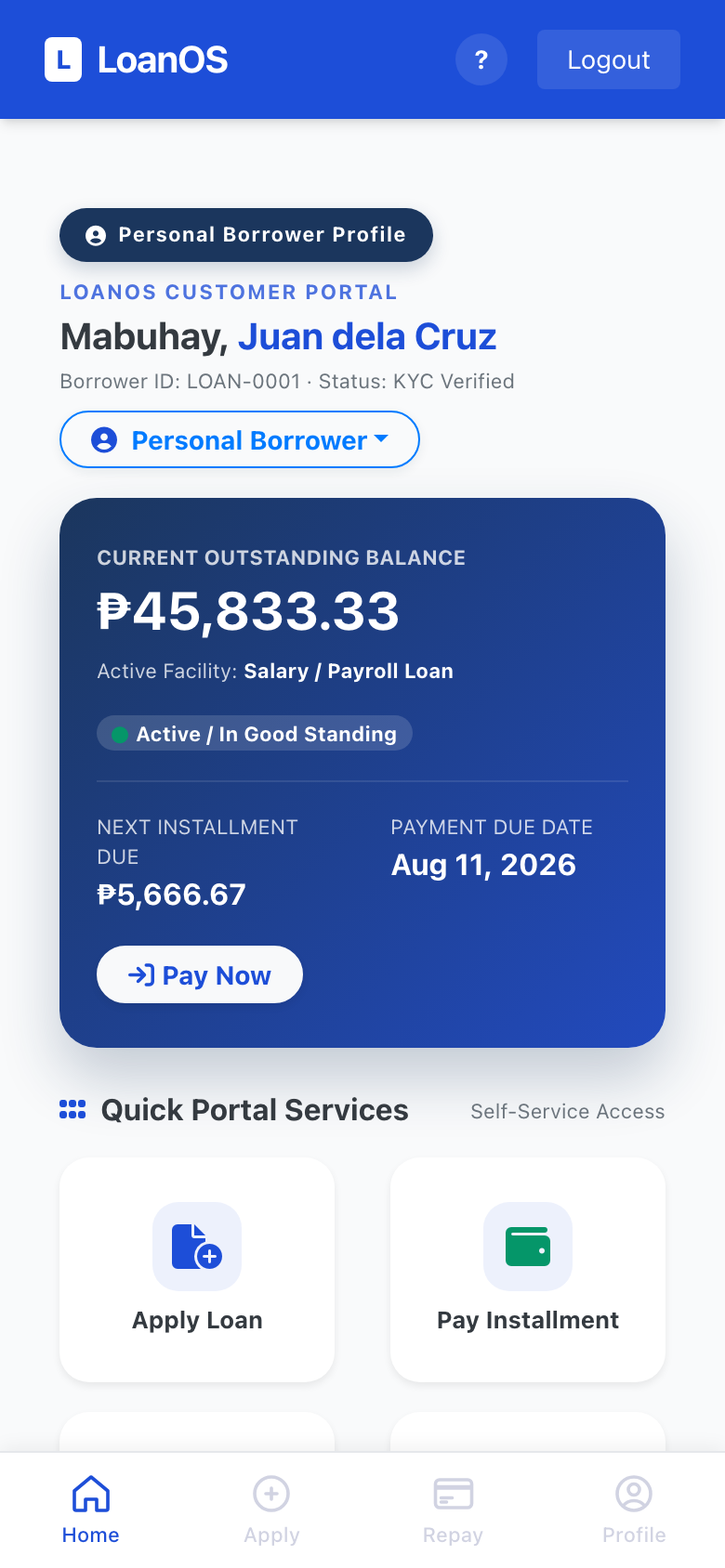
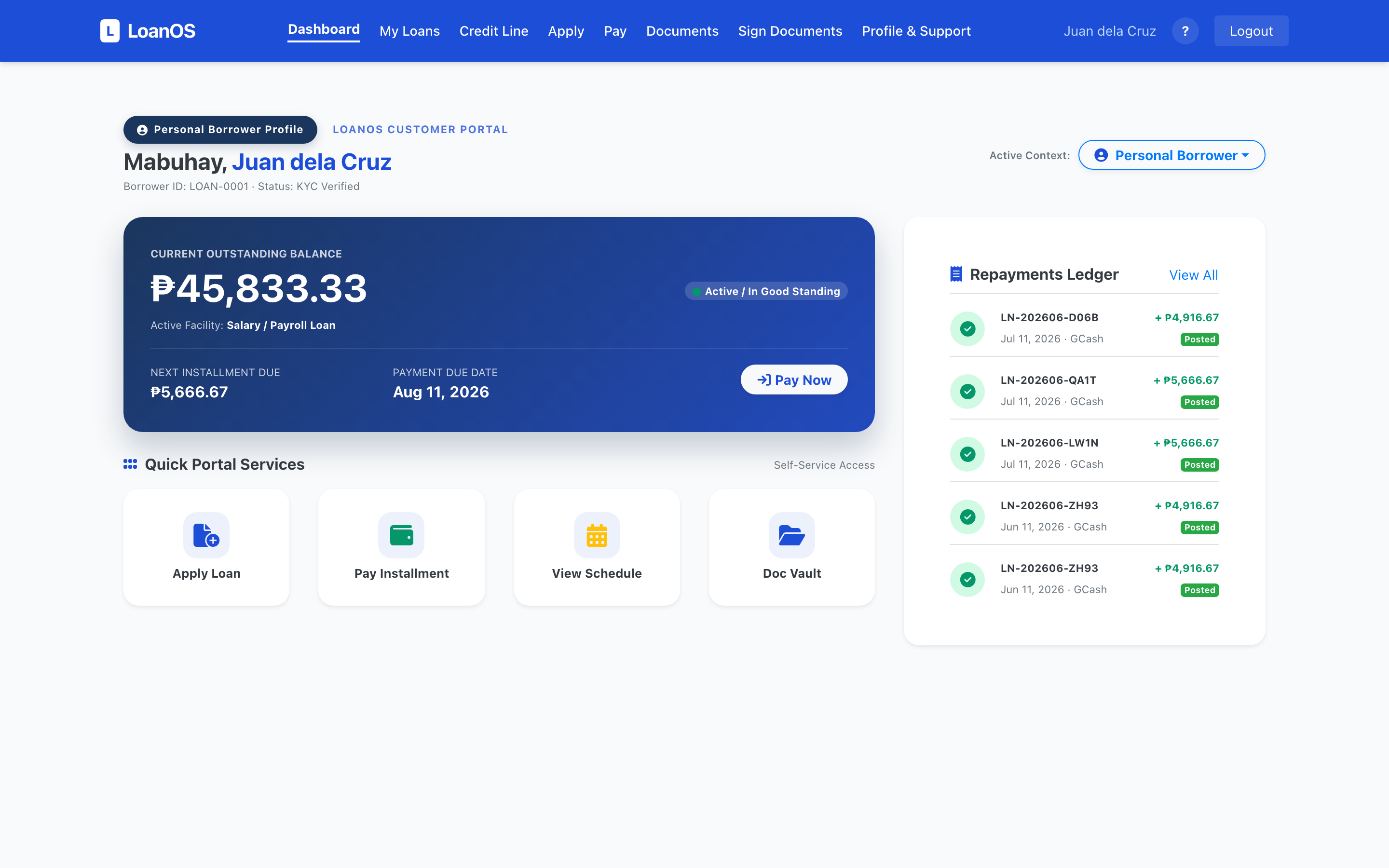
A clean, installable PWA where borrowers see their balance, next installment and full repayment ledger — and pay the way they already do, through GCash, Maya or InstaPay.

Two walkthroughs — one from the borrower's seat, one from the back office.
Borrower experience
Apply in minutes, verify identity, draw the funds and repay through GCash, Maya or InstaPay — all from a phone.
SME & revolving credit
DSCR-based SME underwriting, then a revolving facility — drawdowns under a headroom lock, cycle statements and a Minimum Amount Due.
Risk & finance
Champion-challenger scorecards, ECL staging and provisioning runs, a five-class chart of accounts and BIR-ready books that tie.
Collections & recovery
PAR-banded worklists, a dialing workbench with promises-to-pay, self-routing collector queues, PDC clearing and agency endorsement.
Stacked against the four ways Philippine lenders run their books today.
| Capability | LoanOS Purpose-built for PH | Core banking suite (Temenos / FLEXCUBE) |
Foreign lending SaaS (global vendors) |
Spreadsheets / in-house |
|---|---|---|---|---|
| SEC MC 14 rate-cap guardrails | ● Built-in | ✕ Custom build | ✕ Not localized | ✕ Manual |
| CIC credit-bureau integration | ● Native driver | ◑ Add-on | ✕ Not supported | ✕ None |
| AMLA / goAML & UN sanctions | ● Built-in | ◑ Module | ◑ Generic | ✕ Manual |
| Truth-in-Lending (RA 3765) disclosures | ● Auto-generated | ◑ Configurable | ✕ Not localized | ✕ Manual |
| BIR DST & PH fee handling | ● Configurable | ◑ Custom | ✕ No | ◑ Manual |
| Group / microfinance & field collection | ● Built-in | ◑ Limited | ◑ Varies | ✕ None |
| GCash / Maya / InstaPay & salary deduction | ● Native | ◑ Integration project | ◑ Custom | ✕ Manual |
| Double-entry GL ledger & audit trail | ● Immutable | ● Yes | ◑ Varies | ✕ Error-prone |
| Mobile-first borrower PWA | ● Included | ✕ Separate project | ◑ Varies | ✕ None |
| Time to go live | ● Weeks | ✕ 12–24 months | ◑ Months | ● Immediate* |
| Revolving credit lines & drawdowns | ● Flagship | ✕ Costly module | ✕ Term loans only | ✕ Impossible |
| PFRS 9 ECL staging & provisioning | ● Built-in | ● Enterprise tier | ✕ Not localized | ✕ Manual |
| Chart of accounts & journal vouchers | ● Built-in | ● Built-in | ✕ Export only | ✕ Manual |
| BIR CAS books & Form 2307 | ● Built-in | ✕ Custom build | ✕ Not localized | ✕ Manual |
| Champion-challenger decisioning | ● Built-in | ● Enterprise tier | ✕ Add-on | ✕ Impossible |
| Collector queues, PTP & agency endorsement | ● Built-in | ✕ Custom build | ✕ Add-on | ✕ Manual |
| PDC vault, clearing & BP 22 evidence | ● Built-in | ✕ Custom build | ✕ Not localized | ✕ Manual |
| Data Privacy consent ledger & erasure | ● Built-in | ✕ Custom build | ✕ Partial | ✕ Manual |
| Source code ownership & white-label | ● You own & rebrand it | ✕ Vendor-locked | ✕ Vendor's product | ◑ Files only |
| Hosting & data residency control | ● Your infra, any region | ◑ Vendor-defined | ✕ Vendor cloud only | ◑ Your device |
| Commercial model | ● One-time perpetual licence | ✕ Licence + integrator | ✕ Recurring per-seat SaaS | ◑ Cheap, then costly |
● built-in · ◑ partial / requires work · ✕ not available. *Spreadsheets are "free" until the first examination finding, reconciliation error, or growth ceiling. Vendor names are illustrative of each category, not endorsements.
Financing companies, lending companies, cooperatives and fintech lenders get bank-grade controls without a bank-grade budget or headcount.
Pre-built PH compliance means you configure products and launch — instead of funding a multi-year core-banking integration with a system integrator.
SEC, BSP, AMLC, CIC and Data Privacy obligations are wired into the workflow — so you pass examinations because the system never let you off the rails.
From your first hundred loans to a portfolio with group lending, payroll deduction and field collection — one platform grows with you.
LoanOS is not SaaS. Under a source-available license you receive a copy of the source code, brand it as your own, deploy it wherever you choose, and keep full control of your data and your roadmap.
You receive the complete source under a perpetual license. Read every line, audit it, and never be held hostage to a vendor's roadmap or release cadence.
White-label from the ground up — your name, logo, colors and domain across the borrower app and staff console. Ship it to market as your product, not ours.
Your cloud, your on-prem data center, your region of choice. No mandatory vendor cloud, no per-seat metering, no usage caps that throttle growth.
Borrower PII and loan records sit in infrastructure you own — making Data Privacy Act (RA 10173) and BSP/SEC data-residency compliance far simpler to demonstrate.
Modify and extend the platform for your own products and workflows. The code is yours to evolve — by your team or ours — as the business grows.
A one-time license to the delivered version, yours to run indefinitely. No subscription that can be switched off, no renewal leverage held over you.
Nine facility types ship in the catalogue on day one — Personal Cash, Salary & Payroll, Auto / Vehicle Financing, Consumer Goods, Multi-Purpose, Microfinance individual and group, SME Term, SME Revolving Credit Line and Real Estate / Housing up to 20 years. Term loans and drawdown facilities run side by side on one ledger.
Group guarantees, weekly cadence and field-officer cash collection, out of the box.
A mobile-first borrower app and e-wallet rails to launch a digital product fast.
Employer deduction batches, CSV exports and reconciliation built for payroll lending.
LoanOS pairs decades of business-critical engineering with an AI-powered delivery model — so you get depth and speed, not a trade-off between them.
Implementation partner
For 25 years, BlastAsia has built and implemented business-critical software for global enterprises — bringing deep engineering discipline, domain expertise and delivery rigor to every LoanOS deployment.
AI-Powered Software Factory
Xamun is an AI-powered software factory that brings speed and reliability to commercial software delivery at scale — compressing what once took years into months, without sacrificing quality.
Book a 30-minute walkthrough, or jump straight into the live demo environment and click through it yourself.